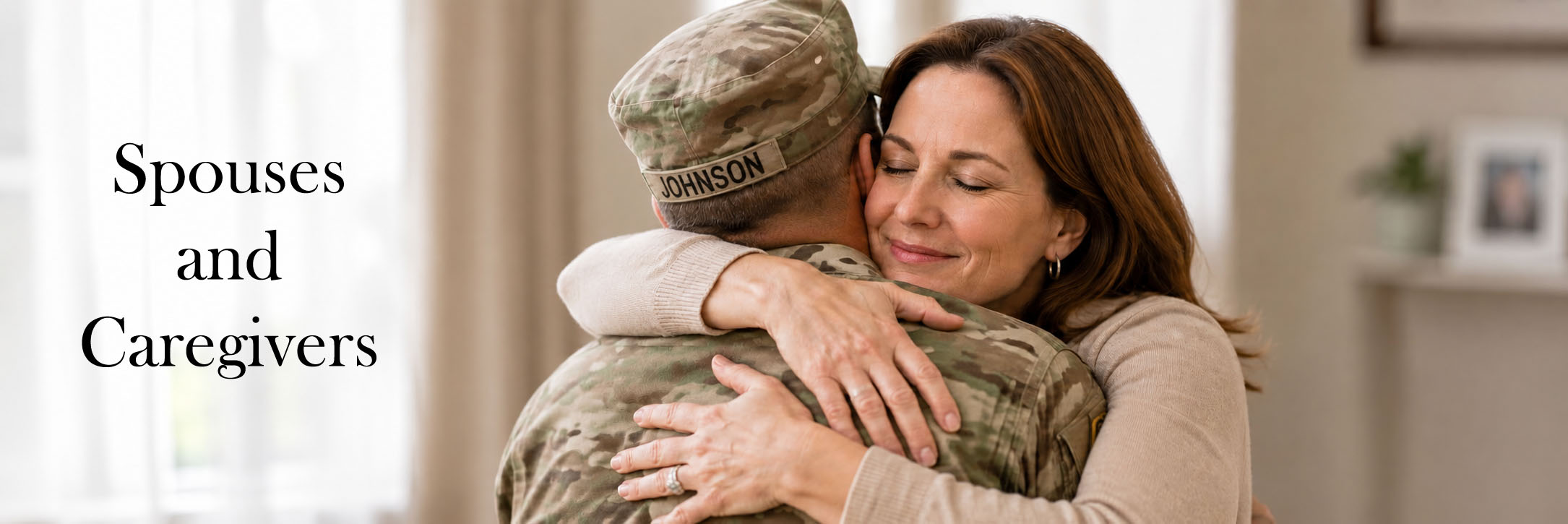
Military service affects entire families, not just the person who wears the uniform. Long before many combat veterans return home, spouses and caregivers have often learned to live with deployments, uncertainty, interrupted plans, and the responsibility of holding family life together while someone they love serves far from home. Those experiences require resilience, adaptability, and strength that often go unnoticed.
For many families, however, the greatest challenges begin after the deployment ends.
Combat can leave lasting effects that are difficult to understand if you have never experienced them yourself. Your veteran may struggle with nightmares, restless sleep, hypervigilance, emotional withdrawal, anxiety, depression, anger that seems to come from nowhere, or periods of isolation. You may worry about alcohol or other coping behaviors, wonder how to respond when your loved one feels overwhelmed, or quietly carry concerns about their safety that are difficult to share with anyone else.
Over time, many spouses and caregivers find themselves becoming the person who keeps everything moving. They manage the household, raise children, coordinate appointments, maintain finances, anticipate difficult days, absorb emotional stress, and try to create stability for everyone else. In the process, many discover that their own wellbeing has gradually moved to the bottom of the list.
If this sounds familiar, we want you to know something that many spouses rarely hear:
Your wellbeing matters too.
At Project New Day, we believe that supporting the spouse is not separate from supporting the veteran. Healthy families become one of the strongest foundations for healing, resilience, and hope.
A Different Kind of Support
Many programs focus primarily on helping the veteran. Others offer encouragement, peer support, or counseling referrals for spouses. Those resources are valuable and have helped many families.
Project New Day takes a different approach.
You do not need to be in crisis to benefit from the program. Many participants join because they simply want better tools, greater peace.
Our program combines practical coaching with evidence-informed education that helps spouses better understand what they have been living with and why these challenges develop. We explore how combat stress can affect the nervous system, relationships, emotions, habits, communication, and family life. Understanding these patterns often reduces confusion, self-blame, and frustration while creating new possibilities for responding with greater confidence and steadiness.
Just as importantly, the program helps spouses better understand themselves. Living alongside chronic stress changes people. Many develop patterns of coping that once served an important purpose but eventually become exhausting to maintain. Learning to recognize those patterns with compassion, rather than criticism, is often the beginning of meaningful change.
Throughout the program, participants learn alongside other spouses and partners who understand many of the same realities. The atmosphere is respectful, supportive, and practical. No one is expected to have all the answers, and no one has to pretend everything is fine.
What You Can Expect
- A structured 12-week program delivered through weekly 90-minute Zoom sessions
- Separate groups exclusively for spouses and caregivers of combat veterans
- Small cohorts of no more than eight participants
- Practical tools that can be applied immediately in daily life
- Experienced Project New Day coaches who guide learning in a supportive, collaborative environment
- Immediate openings available
- No cost to participate
Contact us today!
Alternatives to the Project New Day Program
Project New Day wants to bring your awareness to similar programs that may be of interest to you. Please see our Resources page for more information.