Coaching Instructions

Overview

This page provides guidance for coaches delivering the Project New Day model. While the Compassionate Coaching page explains the spirit of the approach, this page focuses on how to implement it in a clear, intentional, and practical way.

Project New Day coaching is relationship-centered and knowledge-based. The relationship provides safety and encouragement. The model provides clarity and direction. Both are essential.

Improving Coaching Outcomes
Regular reminders of how the current session, topic, or exercise fits into the broader past, present, and future framework help participants feel grounded and purposeful. When they can see how each exploration connects to their guiding intentions and long-term direction, motivation strengthens, confusion decreases, and the work feels coherent rather than fragmented.

Research on helping relationships suggests that coaches can meaningfully improve outcomes by:

  • Maintaining unconditional positive regard at all times
  • Expressing encouragement when participants show initiative or effort
  • Continuing to refine their own understanding of the model and the underlying science

Theory and technique matter, and the Project New Day model provides them. However, they are delivered through your presence. Calmness, consistency, and belief in the participant’s capacity are powerful influences.

Kristin Neff, Ph.D

“One of the most important elements of self-compassion is the recognition of our shared humanity. Compassion is, by definition, relational. Compassion literally means “to suffer with,” which implies a basic mutuality in the experience of suffering. The emotion of compassion springs from the recognition that the human experience is imperfect, that we are all fallible.”

Thoughtful Self-Disclosure and Shared Humanity
Appropriate self-disclosure can strengthen connection when used carefully. Briefly acknowledging challenges you have faced can normalize struggle and reinforce the idea of shared humanity.

Self-compassion research emphasizes that suffering and imperfection are universal human experiences. When participants understand they are not uniquely flawed, shame softens and openness increases.

Self-disclosure should never dominate the session. Its purpose is to create mutuality, not shift focus. The participant remains at the center of the conversation.

Introducing the Model to Participants
Before presenting individual web pages or videos, it is important to introduce the coaching model as a coherent “toolbox” framework. You might explain: The Project New Day coaching model is a carefully designed collection of evidence-informed life-improvement concepts intended to help you build your best possible life. The material is presented in a logical sequence that supports clearer thinking, steadier emotional regulation, and more intentional growth. The model addresses three broad areas:

  • Understanding the past
  • Strengthening the present
  • Orienting toward the future 
Coaching Model
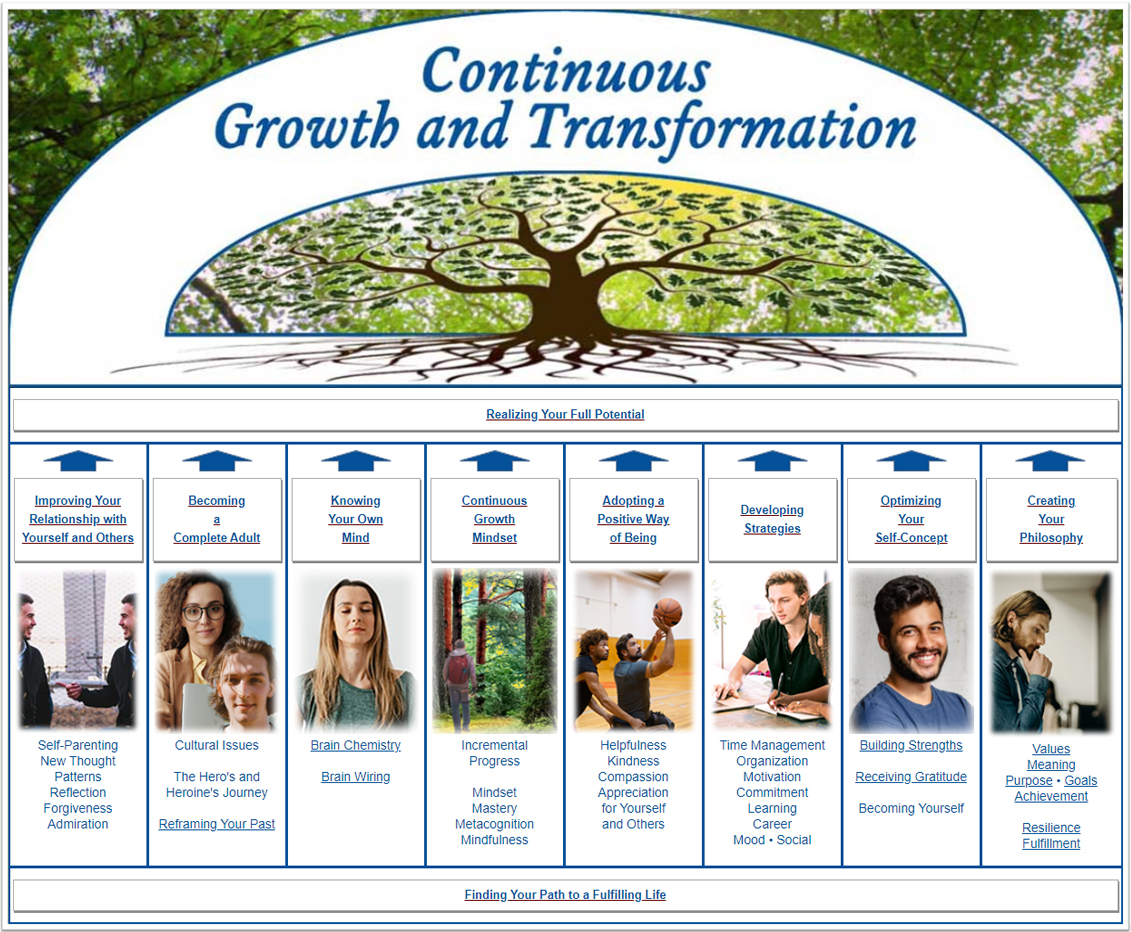
Click the image to navigate to coaching model

Within those areas, participants explore themes from left to right such as unburdening from the past, learning how the mind works, adopting a positive and strengths-based way of being, creating a personal philosophy grounded in values and meaning, and maturing into a capable, self-directed adult.

It is helpful to emphasize that the goal is not to learn a few ideas and move on. The concepts are paths. Participants are encouraged to view them as lifelong directions. Small, consistent improvements compound over time. When someone commits to continuous growth, life becomes increasingly organized, purposeful, and meaningful.

It is also appropriate to say, with confidence, that by the end of the program participants will understand more about intentional personal development than the vast majority of people. Very few individuals take the time to systematically study how growth, regulation, purpose, and resilience actually work.

The Role of Structure in Emotional Regulation
The Continuous Growth and Transformation Model is intentionally organized. When participants learn concepts in sequence, their internal experience often becomes more organized as well.

Disorganization in thinking frequently contributes to emotional reactivity. As clarity increases, anxiety often decreases. When participants understand how their past shaped them, how their nervous system operates in the present, and how they are intentionally building their future, they experience a greater sense of steadiness and agency.

Forgiving, Honoring, and Caring for the Self
Many participants arrive having experienced early relational wounds such as neglect, abandonment, chronic criticism, or abuse. These experiences often leave behind internalized self-criticism and difficulty with self-care.

One important reframe is that, as adults, participants can begin providing for themselves the acceptance, protection, and forgiveness they may not have consistently received. Learning to treat oneself with the same steady kindness one would offer a child can feel unfamiliar. For some, it may even seem overly soft, sentimental, or unnecessary. If that reaction arises, it can be helpful to gently ask, “How has pushing through with harsh self-criticism been working for me?” Many discover that relentless toughness has not produced peace, vitality, or sustainable growth.

Coaches may suggest simple internal affirmations such as, “This is how I honor myself,” when participants engage in healthy routines, complete responsibilities, or act in alignment with their values. Over time, repetition of this practice begins to balance long-standing negative self-messages and builds a more stable, respectful inner dialogue.

Transforming Reactivity into Compassionate Curiosity
When participants describe being triggered or uncomfortable with others, you may ask permission to share a structured reflection process. Encourage them to consider:

  • What specifically was the other person doing?
  • What are multiple possible explanations for that behavior?
  • What feeling arose in me?
  • When have I felt this before?

This line of inquiry helps participants determine whether a current reaction is linked to earlier protective patterns. As Self-leadership strengthens, reactivity often shifts toward curiosity. The long-term goal is not emotional numbness, but steadiness and compassionate perspective.

Using the Coaching Model in Practice
The visual coaching model represents Continuous Growth and Transformation. It is designed to be navigated intentionally.

The natural starting point is a self-assessment and the development of goals, or “intentions,” that will guide participants through the Project New Day program and their broader life-improvement efforts. See the Creating Intentions instructions below. Having these intentions in mind will help increase participants’ motivation to engage with the process and the model’s framework. There are eight core topic areas that form the main body of the program. The order of presentation of the topics within these areas is provided below.

Nearly all of the topic pages include video presentations. Many include additional talks that can be assigned between sessions to deepen learning. Encourage repetition, reflection, and application rather than passive consumption.

Growth strengthens through revisiting and applying, not merely through exposure.

Session Sequencing and Pacing
Early sessions should focus on foundational concepts such as understanding how the mind works, including brain chemistry and regulation. Many later topics build upon this understanding.

Deeper material related to reframing the past or connecting with deeper emotional layers should generally be introduced after rapport and stability are established.
The pacing should feel organized and intentional, not rushed. Participants benefit from knowing there is a clear progression.

The Coach’s Orientation
Throughout the process, continually reinforce Self-leadership. Encourage participants to ask themselves:

  • What am I trying to accomplish right now?
  • How do I want to go about it?

This shifts growth from passive participation to deliberate engagement.
The overarching aim is not simply symptom reduction. It is helping participants experience themselves as coherent, capable systems who can understand their past, regulate themselves in the present, and move into the future with clarity and purpose.

Compassionate coaching, delivered within a structured and evidence-informed framework, allows that transformation to unfold in an organized and sustainable way.

Creating Intentions: Improving Motivation for Engagement

Introduce the Continuous Growth and Transformation toolbox as a framework for self-understanding, and emphasize that its power depends on clear, evolving intentions. Creating intentions helps participants translate insight into direction, clarifying how they want to grow and what kind of life they want to shape.

Describe the work as integrating three connected areas:

  • Understanding the past
  • Strengthening the present
  • Orienting toward the future

Invite participants to complete the Creating Intentions worksheet early in the process.

Throughout the program, remind them that intentions should evolve as insight deepens. Encourage periodic review and revision to maintain alignment with meaningful growth and well-being.

Over time, this intentional practice strengthens Self-leadership. Participants begin to see themselves not as problems to fix, but as capable, adaptive systems able to learn, integrate new awareness, and move forward with purpose.

Worksheets

Structured worksheets support clarity, accountability, and integration throughout the program. You will find links to the program worksheets on the Resources page.

Begin the first session by completing the Creating Intentions Worksheet. This document anchors the coaching process and establishes direction from the outset.

Additional worksheets support specific sections of the program:

  • Creating Intentions Worksheet (when presenting the Coaching Overview page)

  • Values Clarification Worksheet (when presenting the Circle of Fulfillment – Values page)

  • Strengths Classification (when presenting the Leveraging Your Strengths page)

  • Posttraumatic Growth Inventory (when presenting the Posttraumatic Growth page)

Clients typically respond well to structured worksheets. Revisit the Creating Intentions worksheet mid-program or at the conclusion of coaching to reinforce engagement, recalibrate goals, and strengthen alignment with the overall process.

Assigning Reading

The clients who become quite interested in the coaching model life-improvement concepts are typically the ones who progress the most rapidly. Letting clients know this often motivates them to do work outside the coaching sessions. Nearly all of the coaching model pages have one or more videos at the bottom that can be assigned as homework.

Additionally, assigning Viktor Frankl’s seminal book, “Man’s Search for Meaning” is a great way to underpin the concepts presented on the “Circle of Fulfillment – Meaning” page. The book is short, in the public domain, and there are PDFs available online at no cost.

Coaching Session Content

Below you will find a template that describes the 90-minute format for the 12 Project New Day Program sessions. Following that is a list of the specific topics to be covered each week.

The content for all topics may be found in the Coaching Model on this website.

General Session Format

DurationActivityClock start
0:15Participant Check-in (name, location, a few words about themselves)0:00
0:05Topic #1 Introduction
Explain why this week’s topic is helpful. Include lived experience
Describe how it fits into the Growth and Transformation Model
0:15
0:10Topic #1 Presentation0:20
0:15Topic #1 Discussion
Were they already acquainted with the content?
How does it address their intentions
0:30
0:15Mindfulness break
Calming with eyes closed beginning with six cycles of 4-7-8 breathing, upper body scan
See the weekly schedule for the full description.
0:45
0:05Topic #2 Introduction
Explain how the second topic is usually about healing from past wounds and forgiveness
Include lived experience
Describe how it fits into the Growth and Transformation Model
1:00
0:10Topic #2 Presentation1:05
0:10Topic #2 Discussion
Were they already acquainted with the content?
How does it address their intentions
1:15
0:05Closing remarks: Recap of topics and how they fit into the organized toolbox concept
Reminder to be thinking that learning about these life-improvement methods in this way will weave a web of support and well-being
1:25
 Session completion1:30

Weekly Topics

Week First presentation Format Time Second Presentation Format Duration Mindfulness
1 Coaching
and
 Creating Intentions
Video
and
Lecture
2:00 The Nervous System Lecture 10:00 Calming: Basic 4-7-8 breathing and body scan followed by feeling instead of thinking
2 Continuous
Growth
Mindset
Video 5:00 The Change Triangle Lecture 10:00 Calming and then exploring differentiation and unblending. Begin path of promoting harmony among all parts
3 Optimizing
Your
Self-concept
Video 8:00 Leveraging
Your
Strengths
Video 4:00 Calming and then accessing Self-energy, imagine genie rising up from a lamp as Self-leader
4 Gratitude Video 6:00 Brain Chemistry Video 9:00 Calming and then connecting with managers
5 Assign Man’s Search for Meaning.
Brain Wiring (Neurodiversity)
Video 10:00 Improving Your Relationship
with
Yourself
Video 9:00 Calming and then connecting with managers
6 Values Video 3:00 Connections
and
Self-Leadership
Video 8:00 Calming and then connecting with firefighters
7 Meaning Video 7:00 The Hero’s
or
Heroine’s Journey
Video 9:00 Calming and then connecting with firefighters
8 Purpose Video 4:00 Upstairs Downstairs Video 10:00 Calming and then learning who is being protected
9 Goals Video 2:00 Internal Family Systems Video 11:00 Calming and then supporting exiles
10 Posttraumatic Growth Video 3:00 Schemas Video 5:00 Calming and then gifts from exiles
11 Developing Strategies Video 5:35 Mental Fitness Trainer and
Neural Circuit Training
Lecture 10:00 Calming and then appreciating uniqueness
12 Realizing
 Your
Full Potential
Video 4:00 Resilience Video 2:00 Calming and then learning to enjoy the path to harmony